What Is the Difference Between VMBO, HAVO and VWO in the Netherlands?

Understanding the difference between VMBO, HAVO and VWO is essential for parents navigating the Dutch secondary education system, especially for expat and international families.

At first glance, the system can seem complex. Students are placed into different academic levels at a relatively young age, and each path leads to a different type of future education. However, once you understand how it works, the structure becomes much clearer—and much more logical.

Key Differences Between VMBO, HAVO and VWO

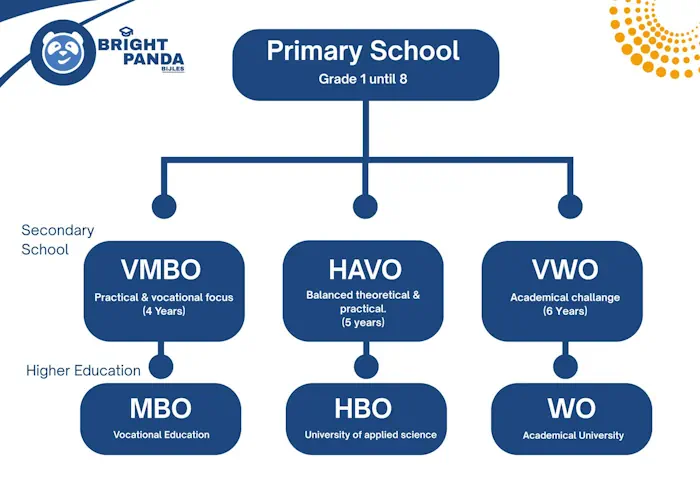
The difference between VMBO, HAVO and VWO is their academic level and the type of education they prepare students for within the Dutch school system.
  • VMBO prepares students for vocational education (MBO)
  • HAVO leads to higher professional education (HBO)
  • VWO prepares students for university (WO)
  • Prepare for important tests and final exams
  • Improve study skills and time management
  • Increase academic confidence
  • Work toward moving to a higher education level
  • Strengthen understanding of specific subjectsStrengthen understanding of specific subjects
  • Prepare for important tests and final exams
  • Work toward moving to a higher education level
  • Improve study skills and time management
  • Increase academic confidence
Each level is designed to match different learning styles, academic strengths, and long-term goals.

In simple terms, the Dutch education system divides students into three pathways based on ability, pace, and preferred way of learning.
Swap arrow

Ready to Learn with More Confidence?

Schedule a free trial lesson and discover how personalized tutoring can help you make faster and lasting progress. Start Your Free Trial Today.
green tick
Free trial lesson
green tick
No credit card required
green tick
Cancel anytime

How the Dutch Secondary Education System Works

To understand why tutoring is so common, insight into the structure of the education system is essential.
In the Netherlands, students transition to secondary school at around age 12. At this point, they are placed into one of the three main education levels: VMBO, HAVO, or VWO.

This placement is based on a combination of teacher recommendations, academic performance, and standardized test results.

Unlike many other countries, where all students follow the same academic track for longer, the Dutch system introduces differentiation early. While this may feel unfamiliar for expat families, it is designed to help students learn at a level that suits them best.

Understanding how secondary education in the Netherlands works is key to making confident and informed decisions.

Comparing VMBO, HAVO and VWO Pathways

Niveau Duur Academisch niveau Focus Leidt naar
VMBO 4 years Practical Skills-based learning MBO
HAVO 5 years Intermediate Theory + application HBO
VWO 6 years Advanced Academic/theoretical University / WO
The main difference between these levels is the balance between practical and theoretical learning. As students move from VMBO to VWO, the curriculum becomes more academic, more independent, and more abstract.

VMBO Explained: Structure and Learning Approach

VMBO (Voorbereidend Middelbaar Beroepsonderwijs) is a practice-oriented educational pathway designed for students who learn best through hands-on experience.

The program lasts four years and focuses on developing practical skills in a structured and supportive environment. Rather than emphasizing abstract theory, VMBO helps students apply knowledge in real-world contexts.

Different VMBO levels explained

Within VMBO, there are different tracks that vary in academic level:
  • VMBO-basis
  • VMBO-kader
  • VMBO-gemengd
  • VMBO-theoretisch
These tracks differ in how much theory is included and how independently students are expected to work. For example, VMBO-theoretisch includes more academic content and can lead more easily to HAVO, while VMBO-basis is more focused on direct vocational preparation.

What comes after VMBO?

After VMBO, most students continue to MBO (vocational education). In some cases, students can move on to HAVO, depending on their performance.

Students at VMBO level often benefit from structured academic support across multiple subjects to build confidence and strengthen core skills.

HAVO Explained: Balanced Academic Pathway

HAVO (Hoger Algemeen Voortgezet Onderwijs) offers a balanced pathway between practical and theoretical education.

Over five years, students develop academic knowledge alongside the ability to apply it in real-life situations. This makes HAVO a strong option for students who are capable academically but prefer applied learning over purely theoretical study.

After completing HAVO, students typically continue to HBO (higher professional education), where the focus remains practical and career-oriented.

HAVO vs VWO: Academic Depth and Expectations

The difference between HAVO and VWO lies in academic depth and future pathways.

HAVO prepares students for HBO (applied sciences), while VWO prepares students for university (research-based education). As a result, VWO requires a higher level of independence, stronger analytical skills, and the ability to handle more complex academic material.

Example: HAVO vs VWO in practice

A HAVO student may perform well in structured environments and applied subjects but find highly abstract concepts more challenging.

A VWO student, on the other hand, is expected to work more independently, analyze complex problems, and manage a faster academic pace.

This difference is not about intelligence, it is about learning style and academic preference.

VWO Explained: Preparation for University

VWO (Voorbereidend Wetenschappelijk Onderwijs) is the most academically demanding level in Dutch secondary education.Students follow a six-year program that focuses on theoretical understanding, critical thinking, and independent learning. This prepares them directly for university.

Within VWO, students can follow Atheneum or Gymnasium, with Gymnasium including classical languages such as Latin and Greek.

VWO is best suited for students who enjoy academic challenges and are comfortable working with abstract concepts.

Which Level Leads to University in the Netherlands?

VWO is the direct pathway to university in the Netherlands. Students at this level develop the academic skills required for higher education, including independence, discipline, and analytical thinking.

However, there is also an alternative route: HAVO → HBO → University (via transfer).

While this path takes longer, it provides flexibility for students as they grow academically.

Understanding HBO Within the Dutch Education System

HBO (Hoger Beroepsonderwijs) or University of applied sciences, is part of higher education, not secondary school.

It focuses on practical, career-oriented learning and prepares students for specific professions. Students usually enter HBO after HAVO or MBO.

Understanding this distinction is essential when looking at the full education pathway in the Netherlands.

Can Students Move Between VMBO, HAVO and VWO?

Yes, the Dutch system allows flexibility between levels.

Students can move from VMBO to HAVO or from HAVO to VWO, but these transitions require strong academic performance, motivation, and positive school recommendations.

How difficult is it to switch levels?

While switching is possible, it is not automatic. Many students need to catch up on theoretical knowledge or adapt to a more demanding academic pace.

With the right structured academic support, these transitions become significantly more achievable.

How to Choose the Right Level for Your Child

There is no “best” level, only the level that best fits the student.

The right choice depends on several factors, including learning style, academic confidence, motivation, and long-term goals. A level that is too demanding can lead to stress and frustration, while a level that is too easy may reduce motivation and engagement.

In practice, students tend to perform better and feel more confident when they are placed in a level that matches their pace and way of learning.

For many families, especially expats, this decision can feel uncertain at first. Understanding how the system works, and how each level differs, already makes a significant difference.If your child needs extra support to feel more confident at their current level, structured academic support can help them progress more effectively.

Dutch Education System vs Other Countries

For expat families, one of the biggest challenges is understanding how the Dutch system compares to other countries.

In many education systems, students follow a single academic track for a longer period. In contrast, the Netherlands separates students earlier based on their abilities.

While this may seem restrictive at first, it actually allows students to learn at the right level, progress at an appropriate pace, and avoid unnecessary academic pressure.

Importantly, the system remains flexible, allowing students to move between levels over time.

How Bright Panda Supports Students Across All Levels

Bright Panda is an academic tutoring provider based in the Netherlands, supporting students across VMBO, HAVO and VWO on a daily basis.Based on our experience working with students across these levels, choosing the right academic path early can have a significant impact on long-term success.

We support both Dutch and international students, including expat families adapting to the system for the first time.

Our approach focuses on identifying learning gaps, improving core subjects, and building confidence so students can progress more effectively.

Students often benefit from structured academic support across multiple subjects, especially when adapting to a new system.

Book a free consultation

Frequently Asked Questions About the Dutch School System

Can expat children enter VWO directly?

Yes, expat children can enter VWO directly, but this depends on their academic background, language level, and the school’s assessment.

Schools will usually evaluate previous school reports, teacher recommendations, and sometimes conduct additional tests. In some cases, students may first be placed in a mixed-level class (such as HAVO/VWO) before moving to a final level.

Is VWO significantly harder than HAVO?

Yes, VWO is more academically demanding than HAVO, especially in terms of theoretical depth and independence.

Students in VWO are expected to analyze more complex concepts, work at a faster pace, and study more independently. HAVO, on the other hand, offers a more balanced approach with a stronger focus on applying knowledge in practical contexts.

The difference is not about intelligence, but about learning style and academic readiness.

Can students move between VMBO, HAVO and VWO?

Yes, the Dutch education system allows students to move between levels, but transitions are based on performance and school recommendations.

For example, students can move from VMBO to HAVO or from HAVO to VWO if they demonstrate strong academic results and motivation. However, these transitions can be challenging, especially when students need to adapt to a more theoretical level.

How early do students need to choose their level in the Netherlands?

Students are typically placed into VMBO, HAVO, or VWO around the age of 12, at the end of primary school.

This decision is based on a combination of teacher advice and test results. While this may feel early compared to other countries, the system allows for adjustments over time if a different level becomes more suitable.

What is the Dutch school system explained in simple terms?

In simple terms, the Dutch school system divides students into three main levels after primary school, based on their abilities and learning style.

Each level, VMBO, HAVO, and VWO, leads to a different type of further education, from vocational training to university. The system is structured but flexible, allowing students to move between levels as they develop.

What is the best level for my child?

There is no “best” level overall, only the level that best fits your child.

A good fit means your child can keep up with the pace, feel confident in their learning, and stay motivated over time. Choosing the right level often leads to better academic results and a more positive school experience.

Final Thoughts on Choosing Between VMBO, HAVO and VWO

The difference between VMBO, HAVO and VWO defines the academic path a student will follow in the Netherlands.

Each level offers valuable opportunities, and success comes from choosing the right fit, not the highest level.

Book a free consultation to better understand your child’s academic path in the Dutch education system.